A fair songwriting split is settled on paper while everyone still remembers the session, not from memory years later. Write down who wrote the lyrics, melody, chords and hook, agree on percentages that add up to 100, and get every name and signature on one document before the track goes anywhere. That is how to split songwriting credits fairly, and the whole conversation takes about an hour.
The reason it matters is boring and expensive. Without a signed record of the percentages, performing rights organizations generally pay an equal share or hold the money in suspense until all writers agree, and a music supervisor handling a sync placement will ask for that same record before licensing anything.
Musicians on forums like r/WeAreTheMusicMakers and r/Songwriters describe the same pattern over and over: the split conversation gets postponed because it feels awkward, and then the song does well and nobody remembers what was agreed. Entertainment attorneys answering questions in those threads are blunt about it — a verbal agreement is close to worthless once money is involved.
The process below is general information, not legal advice. Copyright and royalty rules differ by country and state, so get an entertainment attorney involved when the stakes are high or a band partnership is involved.
What You Need
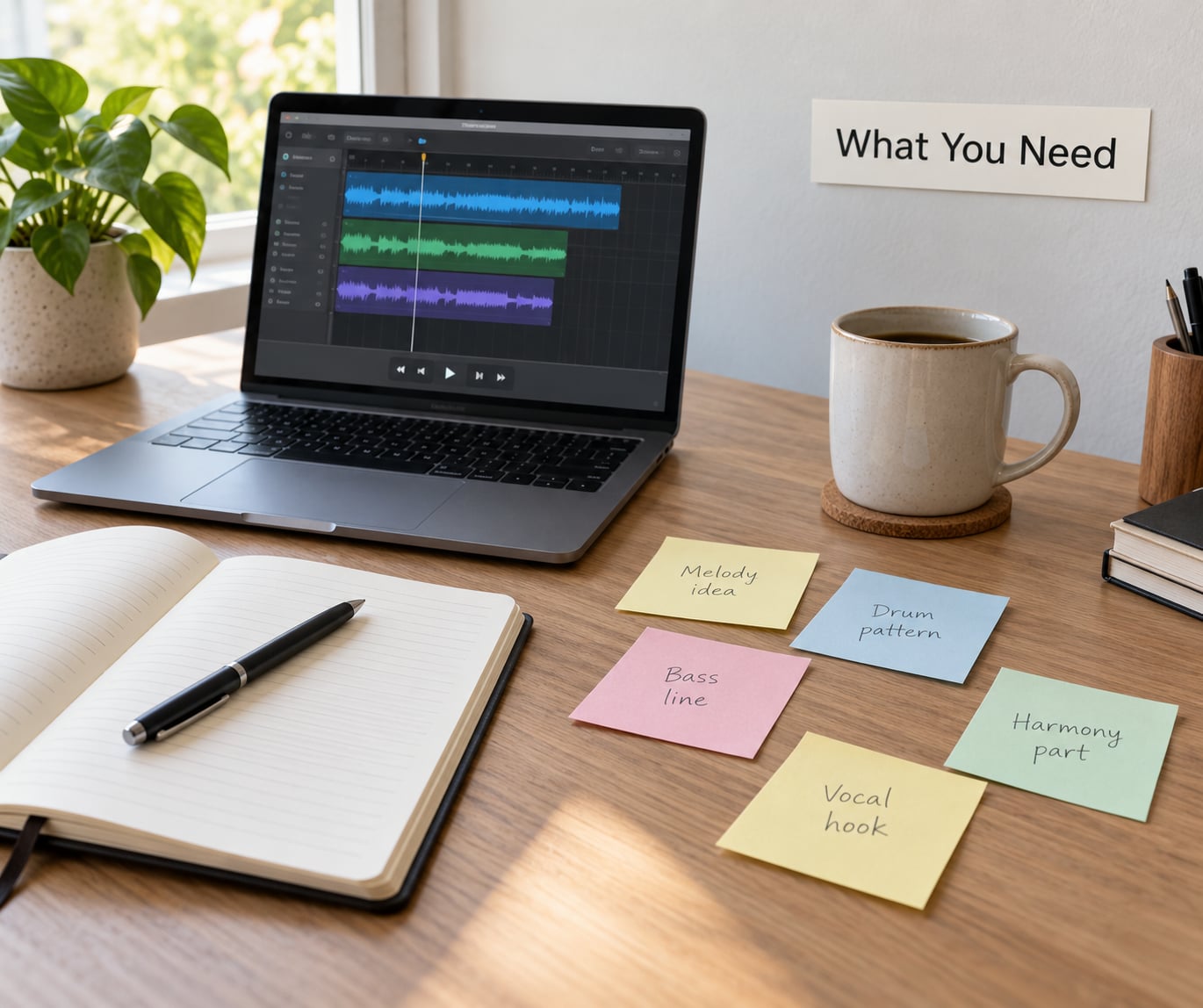
Get these together before the conversation starts. Rushing the paperwork is what turns a fair split into an argument.
- A split sheet. A one-page document listing every contributor, their contribution, and their percentage. Blank templates are widely available from performing rights organizations and royalty administration companies.
- The final versions. Lyrics in text, the melody, and the chord chart. A demo file with dates so you can show who was in the room.
- Legal names. Full legal names, not stage names, plus email addresses and mailing addresses. Registration systems match on exact strings.
- Role notes. A few lines per person describing what they actually contributed.
- A signed-in copy of any existing deal. If one writer already has a publishing administrator or a producer agreement, read it first.
- Publishing details. Each person’s performing rights organization affiliation, if they have one.
- Ten minutes of quiet. Do this at the end of a session, before anyone is packing up, not three weeks later in a group chat.
Step-by-Step: How to Split Songwriting Credits Fairly
1. Identify Everyone Who Contributed Authorship
Start with names, not titles. A co-writer is someone who contributed protectable creative material to the composition itself — words, melody, chord progression, hook, or a distinctive musical idea that ended up in the song.
That boundary matters because roles get confused constantly. A singer who performs but writes no lyric and no melody is a performer, not a co-writer. An engineer, a mixer, and a mastering tech generally own their recorded work, not the composition. Producers sit somewhere in between, which is the subject of step two.
The exception is a session player or guitarist whose riff became the recognizable hook of the record. In the United States, that material can qualify as a contribution to the authorship if it is original, not merely what a performer of that song is expected to play, and the parties treat it as a writing credit rather than a session fee. Producers have lost and won cases on exactly this line.
2. List Each Person’s Creative Contributions
Write down what each person contributed in concrete terms, not in adjectives. “Wrote the lyrics” is usable. “Helped a lot” is not.
Typical entries look like this: top verse and bridge lyrics; the hook and the melodic contour; the chorus melody; the chord progression; the drum pattern that set the tempo; the overall song structure and arrangement concept. The more specific the line, the harder it is for anyone to argue about it later.
Producers should describe their contribution in the same words a court would: did they create the underlying musical composition, or did they take an existing composition and arrange, edit, mix and polish it? Those two answers lead to very different splits.
3. Discuss the Split Before Anyone Signs a Deal
Bring the percentages up before anyone signs a publishing administration agreement or an exclusive producer contract. Once a deal is in place, the paperwork gets heavier and somebody usually has less incentive to move.
Say the numbers out loud rather than sending them in a message. Producers on music business forums describe sending a percentage proposal by text and receiving a reply three weeks later that simply said no, with no counter-offer.
If one writer already has a publishing deal, that writer’s share usually flows through their administrator while the other writer self-publishes. Percentages on the split sheet still need to match what each side reports, or the royalty statement will not balance.
4. Assign Percentages That Add Up to 100
Translate contributions into numbers that total exactly 100 percent. Equal splits are the industry default for genuine co-writes, and most artists who regret their splits regret going unequal rather than equal.
- Two co-writers, equal contribution: 50/50.
- Three co-writers, equal contribution: 33.34 / 33.33 / 33.33. Three equal thirds written as 33/33/33 do not reach 100 and will be rejected or rounded unpredictably by the registry.
- One writer did most of it and everyone is comfortable saying so: 70/30 or 80/20, documented with the contribution lines from step two.
- Four collaborators: use decimals that total 100 rather than 25/25/25/25, which technically equals 100 but leaves no room for a later adjustment.
Composition percentages and master recording percentages are separate numbers and both must total 100 on the same document. Do not merge them into one column.
Note the 80/20 idea that circulates online. It is not a rule, it is not a legal standard, and there is no industry body that awards splits by formula. It describes a common outcome where one writer wrote everything, not a rule you can point to in a disagreement.
5. Write Down the Agreement in Plain Language
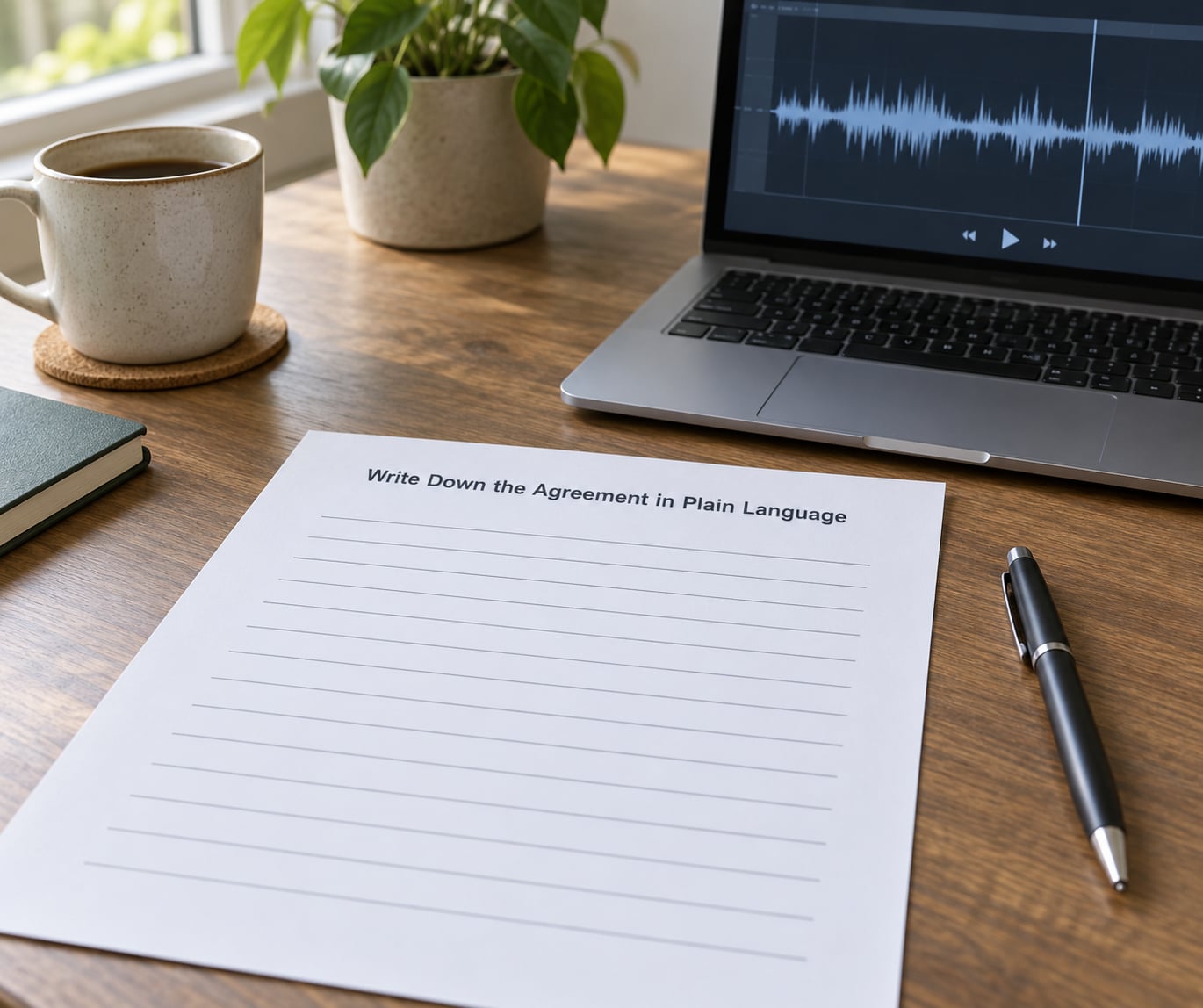
Fill in every field, then have every contributor sign the same copy. A split sheet does not normally need notarizing, but an electronic signature is accepted in most places and dated signatures are worth more than undated ones.
- Song title and the date you agreed the splits
- Full legal name of each contributor, plus email and mailing address
- Contribution description for each person
- Ownership percentage of the composition, totalling 100
- Ownership percentage of the master recording, totalling 100
- Publishing designation: either “self-published, 100% writer’s share” or the administrator’s name and share
- Performing rights organization affiliation for each writer
- Signature and date for each contributor
- A line describing how amendments get made — in writing and signed by everyone
If a contributor is under 18, a parent or guardian usually needs to sign too. That is standard practice and it prevents a mess five years later.
6. Confirm the Final Credits With Everyone
Send the completed sheet to everyone and ask for explicit confirmation. A reply that says “looks good” in a group chat is weaker than a signature, but it is far better than silence.
Then register the song with the same numbers. Every writer submits the same title, the same writer names and the same percentages to their performing rights organization. When two writers submit different percentages for the same work, the royalties go into suspense — unclaimed money that stays stuck until everyone involved agrees in writing.
Keep one signed copy everyone can reach, plus a copy of the copyright registration if you file one. That is the whole job.
Common Mistakes That Cause Credit Disputes
Agreeing on the split verbally
The fix: sign the sheet the same day. Memory drifts, and courts rarely accept “we both said it was 50/50” against a signed sheet showing something else.
Assuming a beat is automatically a co-write
A beat sold as an exclusive license usually comes with a transfer of the underlying composition to the buyer. A non-exclusive lease often keeps the beatmaker’s composition share, which means two people think they wrote the music and only one of them is right. The fix: read the license terms and record who owns the underlying composition in writing.
Splitting the composition and the master together
These are two different copyrights with two different sets of royalties. Put them in separate columns, each totalling 100.
Waiting until after the release
Changing splits after a song is out is legal through a written amendment, but every party has to agree and the registries have to be updated. If royalties are already being paid out, the amendment gets messy fast. The fix: sign before release.
Using the group name as the owner
A band name is not a legal person. In the United States, group members can agree that the band owns the composition, but that agreement has to be written, and members who later leave need a written rule about what happens to their share.
Filing the copyright under one writer’s name only
The fix: all authors file together or join the registration. A solo registration that leaves out a genuine co-writer can cost you the ability to enforce your own share.
Tips for Fair Songwriting Splits
Have a separate band agreement. Band partnership terms, name ownership, and what happens when someone leaves are different questions from who wrote one specific song. Keep them in separate documents. Musicians who banded together in college often learn this the expensive way when the group breaks up.
Treat samples as a separate problem. Clearing a sample is a negotiation about payment and terms, and clearing it does not change who wrote the new song. Note in your split sheet that the composition is original to your writers, and keep the sample clearance paperwork with it.
Build international work into the document. Collaborators outside the United States may belong to societies like PRS, SOCAN, APRA AMCOS, GEMA, SACEM or SIAE. Include a line for society and IPI information, and expect registration across borders to take months. Leaving that blank is how eighteen-month delays happen.
Be careful with AI tools. The U.S. Copyright Office has taken the position that copyright protection requires human authorship, so document exactly what a person wrote. If a person chooses the chords, shapes the melody and edits every output, that is human authorship you can describe. If a generator produced the song from a prompt, do not sign a sheet claiming it as an original co-write.
Use a digital tool for tracking. Spreadsheets work fine for a handful of songs. Once you have dozens, a dedicated split management service that keeps a version history is worth it, because it answers “which version did we sign” without an argument.
Know what happens when agreement fails. Before lawyers: compare the split sheet against the dated files, demos and messages, and put your own contribution in writing. Then have the split reviewed by an entertainment attorney, who can often resolve it with one letter. Litigation over a percentage of a song is expensive enough that most people settle once they see the cost.
Frequently Asked Questions
What is a split sheet in music?
A split sheet is a written agreement that lists every contributor to a song, describes what each person wrote, and records the ownership percentage for the composition and, separately, the master recording. Signing one gives performing rights organizations and publishers a single set of percentages to pay from. Without it, most registries default to equal shares or hold royalties in suspense.
Do producers get songwriting credit?
It depends on what the producer actually created. If they wrote the underlying music, they are a co-writer and take a share of the composition. If they arranged, edited and polished a composition that already existed, they usually own their recorded work and production but not the song. Exclusive beat licenses often transfer composition ownership, while non-exclusive leases usually do not.
What percentage should a producer get for making a beat?
There is no fixed number, and any formula claiming otherwise is folklore. In hip-hop a producer who sells an exclusive beat commonly takes 50 percent of the composition, while the vocalist takes the other half. If the producer only arranged music the artist already wrote, the split is often far smaller, and many artists settle it as a one-time production fee with no ongoing share.
What happens if co-writers cannot agree on splits?
Royalties for that work usually sit in suspense at the performing rights organization, meaning nobody is paid until everyone signs off on the same percentages. Before hiring a lawyer, write down your own contributions with dates, gather session files and messages, and compare them with any existing split sheet. If that fails, an entertainment attorney can usually settle it with a letter rather than a lawsuit.
Can you change a split sheet after signing?
Yes, but only by written agreement. Every contributor has to agree to an amendment, and everyone has to notify their performing rights organization and publisher so the registries match. Changes made after a song is released and royalties are already flowing are the hardest to correct, because past payments have to be accounted for as well as future ones.
Do I need a split sheet if I wrote the song alone?
No, not for authorship purposes, since there is nobody to split with. It is still worth writing a one-page note to yourself listing what you created and when, and saving dated demos. That note matters if a publisher, a sample owner or a band later claims part of the song, because dated files are the cleanest evidence of who wrote what first.
Conclusion: Document the Agreement Before You Release
Do four things before the song goes anywhere: list every person who wrote something, describe their contribution in a sentence, agree on percentages that total 100 for both the composition and the master, and collect a signature from each of them. Then register those exact numbers with your performing rights organization.
The whole process costs an hour and a blank one-page form. Skipping it is what turns a fair split into a five-figure dispute later.
Content on this page is general information about music copyright and royalty practices, not legal advice. Rules vary by country and state, so talk to an entertainment attorney when the money or the relationships are significant.