Sampling is the single most important idea behind the sound of modern hip hop. Producers take a fragment of an existing record — a drum break, a bassline, a guitar lick, three seconds of somebody’s voice — and rebuild it into a new song. Everything that followed, from the heavier drums of boom bap to the chopped vocal hooks of trap, grew out of that habit.
To be specific about the definition: sampling in hip hop is the reuse of a portion of an existing sound recording inside a new recording, with the original fragment either audible as-is or reshaped by chopping, looping, pitch shifting, time stretching, filtering or layering.
What follows is a walk through how that worked, where it came from, what it did to the music, and why it still matters now that any producer with a laptop can pull an isolated vocal out of a finished master.
Table of Contents
- How Sampling Shaped Modern Hip Hop at a Glance
- What Is Sampling in Hip Hop?
- Where Did Hip Hop Sampling Begin?
- How the Breakbeat Made Sampling Sound Bigger
- How Sampling Changed the Sound of Hip Hop Records
- How Chopped Samples and Loops Expanded the Possibilities
- How Sampling Shaped Modern Hip Hop Genres
- How Producers Turn Old Records into New Beats
- What Are the Legal and Ethical Issues Around Sampling?
- Why Sampling Still Matters in Hip Hop
- Frequently Asked Questions
- Conclusion
How Sampling Shaped Modern Hip Hop at a Glance
Hip hop sampling moves through roughly five stages, and each one changed what a beat could sound like as well as who could make it.
| Stage | What producers borrowed | How they used it | Effect on the sound |
|---|---|---|---|
| Breaks and mixing (1970s) | Funk, soul and disco drum breaks | Extended the same break across many bars using the mixer’s extended break button | Room for an MC, and a rhythmic foundation that already felt borrowed and alive |
| Samplers (1980s) | Any record, sliced into a machine | Triggered fragments from pads, re-pitched and re-sequenced | Jagged, dusty timbres; a producer no longer needed an instrument or a band |
| Excavation and collage (late 1980s to mid 1990s) | Whole records, sound effects, multiple sources per track | Stacked dozens of sources, chopped them, hid them under a hook | Dense, maximal productions built as archives rather than songs |
| Reinvention (mid 1990s) | Jazz, funk and soul breaks | Replayed the break under live-feeling instrumentation, flipped and re-tuned the source | Boom bap heaviness, jazz rap, the loop as a hook |
| Fragment economy (2000s to now) | Short, unrecognizable bits, sample libraries, separated stems | Rearranged vocal syllables, pitched whole songs into new keys, blended layers | Trap’s chopped vocals, genre crossing, and a clearance business built on tiny durations |
Notice the direction of travel. Sampling began as a way to get more rhythm out of one record, then became a way to get more music out of one idea, and finally became a way to get an entire record’s worth of arrangement out of a few seconds.
What Is Sampling in Hip Hop?
Sampling means taking a piece of a pre-existing sound recording and using it as part of a new recording. The word covers a wide range of outcomes, from playing a break unaltered to reducing a song to a single filtered vowel sound.
How sampling differs from a replayed beat
A replayed break is played by hand, usually on a drum machine, from a record that is physically present. Sampling means the sound is copied into another recording, so it survives after the source is gone. The technique of replaying a break shaped what people sampled, but the two are not the same act.
How sampling differs from a loop
A loop is a repeating section, and a sample can be looped. But a loop can also be a synth pattern or a recording you made yourself. Sampling is specifically about material that came from somewhere else, which is why the words get tangled in casual conversation.
How sampling differs from interpolation
Interpolation recreates the musical element rather than reusing the actual audio: replaying a melody with new instruments, or singing new lyrics to familiar chords. It is a different legal situation, because the composition is being used rather than the sound recording. Interpolations have their own lawsuit history, which is covered further down.
How sampling differs from a cover
A cover re-performs someone else’s song. Sampling does not have to re-perform anything at all. The most extreme version takes two seconds of a record, chops it into confetti and leaves the listener unable to identify the source, which is legally and creatively a very different proposition from covering a song.
So why did recorded music become the raw material? Because hip hop arrived as a party format built on existing records, and the producers who grew out of that culture never had the impulse to treat recorded sound as finished. It was inventory.
Where Did Hip Hop Sampling Begin?
Hip hop sampling began in the Bronx parties of the early 1970s, where DJs stretched funk, soul and disco drum breaks to make room for whoever was on the microphone. The technique was born from a practical problem: the records everyone owned were short, and the people rapping over them were not.
DJ Kool Herc’s 1973 back-to-school party at 1520 Sedgwick Avenue is the version of the story that gets told most often, and the technique that came out of it was the extended break. Instead of playing a drum pattern start to finish, a DJ would loop the same short section, sometimes with a fader trick layered on top, and the space that created gave the first dancers and later the first MCs somewhere to go.
Dub and Caribbean studio techniques fed into this too. Echo, delay and a heavy low end had already been explored in Jamaican mixing rooms and on New York sound system culture, so the idea of transforming a record in real time was familiar before anyone in the Bronx picked up a mixer.
The split between the DJ and the producer
As hip hop professionalized, the work divided. The DJ handled playback, transitions and the break. A separate producer handled what got recorded. Grandmaster Flash and the Furious Five’s “The Message” in 1982 is usually pointed to as the moment where the studio arrangement, the recorded MC and the engineered beat became one deliberate product rather than a party improvisation.
That split is the hinge of the whole story. Once beats were recorded, they were held to the same rules as any other music production, and the sampler gave producers a way to assemble them out of other people’s records.
How the Breakbeat Made Sampling Sound Bigger
A drum break is the short window in a funk or soul track where the drums take over and the other instruments drop away, usually for a few bars. Isolating that window and repeating it is what made hip hop’s rhythmic base possible, and it is the raw material almost every early sample came from.
Extending the break changed how beats were built, because a looped break is already a complete rhythmic idea. A producer did not need to program a drum pattern, which meant attention could go to the bass, the texture and the MC’s timing instead. When the break got chopped into individual hits and re-sequenced, the beat could swing between patterns without losing its identity.
Three records supplied an enormous share of this material:
- Funky Drummer, James Brown, 1969. The cascading snare and the “Apache” groove that followed it became the most recognizable break of the early 1980s, and it anchors tracks by the Sugarhill Gang and later by Diamond D.
- Think (About It), Lyn Collins, 1971. Harder and funkier, and the source of a break that ran through LL Cool J’s “I’m Bad” and into a lot of regional club and mixtape production.
- Amen, Brother, The Winstons, 1969. A four-on-the-floor figure that producers chopped into rearranged patterns, most famously on N.W.A’s “Amen”, Eric B. & Rakim’s “Let the Rhythm Hit ‘Em”, and later in House of Pain and Busta Rhymes.
Once producers had these four or five bars in their hands, they stopped thinking about records as songs and started thinking about them as a supply of usable pieces. That reframing is the real leap.
How Sampling Changed the Sound of Hip Hop Records
Sampling changed hip hop records by supplying entire layers of arrangement at once, which is why a genre built mostly on vocals could produce records as texturally dense as orchestra records.
In practical terms, a sampled drum break gives a record its weight and its identity, a sampled bassline gives it a low end that sits differently from a synthesized one, a sampled melody gives it instant familiarity, and a sampled texture or vocal gives it grain. A single well-chosen source can do several of those at once, and stacking sources with contrasting textures is how a sparse loop becomes a wall of sound.
Two consequences followed. First, production got faster. A producer working alone, on borrowed equipment, could assemble a finished arrangement in hours instead of booking a band. Second, the sound became generational: an eighteen-year-old in 1994 building a track on a break from 1969 was making a record whose entire point was the conversation between those two dates.
The most sampled artists
Certain catalogues have been mined so often that they function almost like a shared vocabulary. If you have ever wondered who gets sampled the most in hip hop, this is the short list, and it is not close to the top of any chart:
- James Brown — the Funky Drummer and Sex Machine-era catalogue is the most excavated source in the genre, spanning disco, house and hip hop.
- Bob James — smooth production sampled into the fusion, jazz rap and neo-soul records that followed, including the Mardi Gras groove behind Nas’s “N.Y. State of Mind”.
- Loleatta Holloway — “Loleatta’s Mood” and the Albert Carriere catalog supplied hooks for dozens of records; some are cleared uses of her vocal, some use other singers on the same writing.
- David Axelrod — orchestral, string-heavy mid 1970s records that sound like sample-ready by design.
- Led Zeppelin — “When the Levee Breaks” and “D’yer Mak’er” gave a whole generation a heavy rock source to lean on.
- The Winstons, Kraftwerk, the Isley Brothers and Ohio Players — a rhythm section, a synthetic pulse, and a horn section that turned up in hip hop, house and techno for the same reason: they were built from loops-friendly, clearly defined sections.
There is a reason these records keep coming back. Each one has a passage where every instrument plays one memorable thing and then gets out of the way.
How Chopped Samples and Loops Expanded the Possibilities
A straight loop plays the same audio, in order, over and over. Chopping cuts that audio into pieces and re-sequences them, so the same four bars can play as something that never existed on the original record.
The techniques stack, and producers usually combine them:
- Chopping — slicing a break into individual hits and rebuilding the pattern.
- Pitch shifting — changing the key of a loop. A sampler can do it crudely and cheaply, and that inaccuracy became part of the sound people recognise.
- Time stretching — changing the length of a loop without changing its pitch, often to fit a record to a tempo.
- Micro-chopping and vocal chopping — cutting a syllable or a vowel and repeating it to make a hook, which is now a defining move in trap.
- Layering and sidechaining — stacking several sources and ducking them against a kick, so the sample breathes instead of colliding.
- Filtering and EQ — sweeping a loop through a filter so it moves across the track rather than sitting flat.
None of these require the source to be recognizable. That is the technical fact that quietly changed both the sound and the business: once a sample can be unidentifiable, it can also be unlicensed, contested, and settled out of court rather than cleared properly.
How Sampling Shaped Modern Hip Hop Genres
Sampling did not just add flavour to hip hop. It is the reason several subgenres have the rhythmic character they do.
Boom bap
Boom bap took the looped break and put live-feeling weight around it. Drums played with more weight, bass moved with the kick rather than under it, and the loop was treated as a musical section rather than a track to bury. It revived in the early 1990s through a wave of records deliberately aimed at the jazz-and-soul end of the format.
Jazz rap
The vocabulary here is small, precise, and expensive-sounding. Long live strings, Rhodes-style chords, upright bass, and jazz drum phrasing, all of it assembled from records that already had that character.
G-funk
West Coast tracks leaned on long single-note melodic figures and a huge low end. Those melodic lines came straight from records, chopped and stretched, and the whole aesthetic depends on a source that is already melodic enough to carry the weight.
Southern rap
Tempo, not just timbre, is the southern contribution built on sampling. Slowing a borrowed record down, or flipping an obscure soul cut into a lazy two-step pocket, produced a sound that sample-based producers elsewhere found hard to copy.
Underground, alternative and jazz-leaning hip hop
This is where sampling stopped being a shortcut and became an art form. Records in the tradition of 3 Feet High and Rising, the 1990s jazz-jungle crossover, and 1996’s entirely sample-built Endtroducing treat the archive as the point: the production is a curator’s argument about what deserves to be heard now. The Avalanches’ work pushed density further still.
Trap and the current era
Modern production took the smallest fragment of all. A chopped vocal syllable, a pitched R&B hook, a two-bar loop with the top end rolled off, arranged over a fast kick pattern. Sampling is now less about a recognisable hook and more about a specific processed texture that listeners read instantly as hip hop.
How Producers Turn Old Records into New Beats
Turning an old record into a beat is a six-step process, and the order matters because the last step can undo the rest.
- Find the source. Digging through crates is still the romantic version, but most working producers start from sample libraries, reissues, compilations, or a record a friend played them. The technique is usually the same: listen for the moment the record does one thing perfectly.
- Locate the usable section. Load it in a DAW, mark the bars that work, and cut a clean chunk with a little room around it. Keep the section long enough to edit and short enough to process.
- Slice and arrange. Chop into hits or leave it whole. Play the pieces in a new order so the pattern is yours rather than a copy.
- Process it. Pitch, stretch, filter, EQ, add saturation. Processing is what separates a flip from a rip.
- Build around it. Add bass, keys, drums or space. The sample should be a voice in the arrangement, not the whole track.
- Check the rights before anyone hears the beat. Find out who owns the master recording and who owns the composition. If either side is a major label, clearing the sample is a negotiation, not a form.
Producers on forums like r/makinghiphop describe step six as the step that decides whether a beat gets released. The practical consensus is that clearance is realistic for an independent artist with a recognizable source and a real offer from a label, and close to impossible for a beginner with an obscure record and a mailbox full of unanswered emails. That is why so many working producers dig for rare, unidentifiable sources on purpose.
What Are the Legal and Ethical Issues Around Sampling?
There are two separate rights in almost every sample, and confusing them is the most common mistake. The master recording is the actual audio, owned by the artist or label who made it. The composition is the song as written, owned by the writer or publisher. Sampling the audio means dealing with the master; re-recording the melody means dealing with the composition. Producers who clear only one have cleared half of it.
This is general information about how copyright works in the United States, not advice on a specific case. Anyone with real money on the line should talk to a music attorney.
The cases that set the tone
| Case | Year | What it settled |
|---|---|---|
| Grand Upright Music v. Warner Bros. | 1991 | Very short excerpts of a recording can be too small to infringe, which protected brief, recognisably transformative uses |
| Campbell v. Acuff-Rose Music | 1994 | Parody that comments on the original can qualify as fair use |
| Bridgeport Music v. Dimension | 2003 | A looping two-second guitar figure stretched to five seconds was held to exceed what could be called de minimis, and sampling was not fair use on that record |
| VMG Salsoul v. Ciccone | 2018 | Interpolation of a musical element is a use of the composition, not of the sound recording |
| People v. Bridges (California appellate) | 2019 | Digitally copying a fifteen-second snippet is still copying, even when the recording is played back rather than resampled |
| Blurred Lines (settled) | 2013 | A claim that a song copied a chord progression rather than an audio sample still settled for a large sum |
Read together, those cases say two useful things. Tiny, transformed uses have real protection. And the line between homage and copying is judged case by case, which is why the same kind of move can be unremarkable in one record and litigated in another.
Fair use and the de minimis question
De minimis is the argument that a use is so small it is not worth protecting. It has rescued plenty of brief, unrecognizable excerpts. Forum discussion on r/sampling and r/hiphopheads rarely agrees on where the threshold sits, and producers who assume that anything under three seconds is safe are working from a rule no court has actually written down.
Homage or plagiarism?
The community view is closer to consensus than the legal one: sampling is not plagiarism, and credit matters. Sampling is a documented practice with a lineage that runs through blues, jazz, gospel and dub, and hip hop’s borrowing is a continuation of that, not an exception to it. The argument gets heated around samples that recreate a melody without crediting the writer, because that is the point where the practice stops being a conversation and starts being a lift.
What independent producers actually do
Most accept that they cannot afford clearance and manage the risk instead. They dig obscure, sample sparsely, process heavily, and keep documentation of the source in case anyone asks. The alternative, using cleared libraries, costs a share of revenue but removes the problem entirely. The recurring frustration in producer communities is not the law, it is that labels rarely respond to clearance requests from producers they have never heard of.
Why Sampling Still Matters in Hip Hop
Sampling still matters because it changed what a producer is. A beatmaker is now, structurally, a curator and a re-constructor of other people’s music, and that job has an identity that no amount of technical skill alone would give.
It also matters for how the genre discovers music. A sample is a recommendation with a built-in argument, and listeners who follow a sample back to its source end up in record shops, in compilations, in catalogued reissues, and in lineages of influence that span fifty years. The crate-digging instinct is still the engine of a lot of hip hop listening, and stem separation has widened rather than closed it.
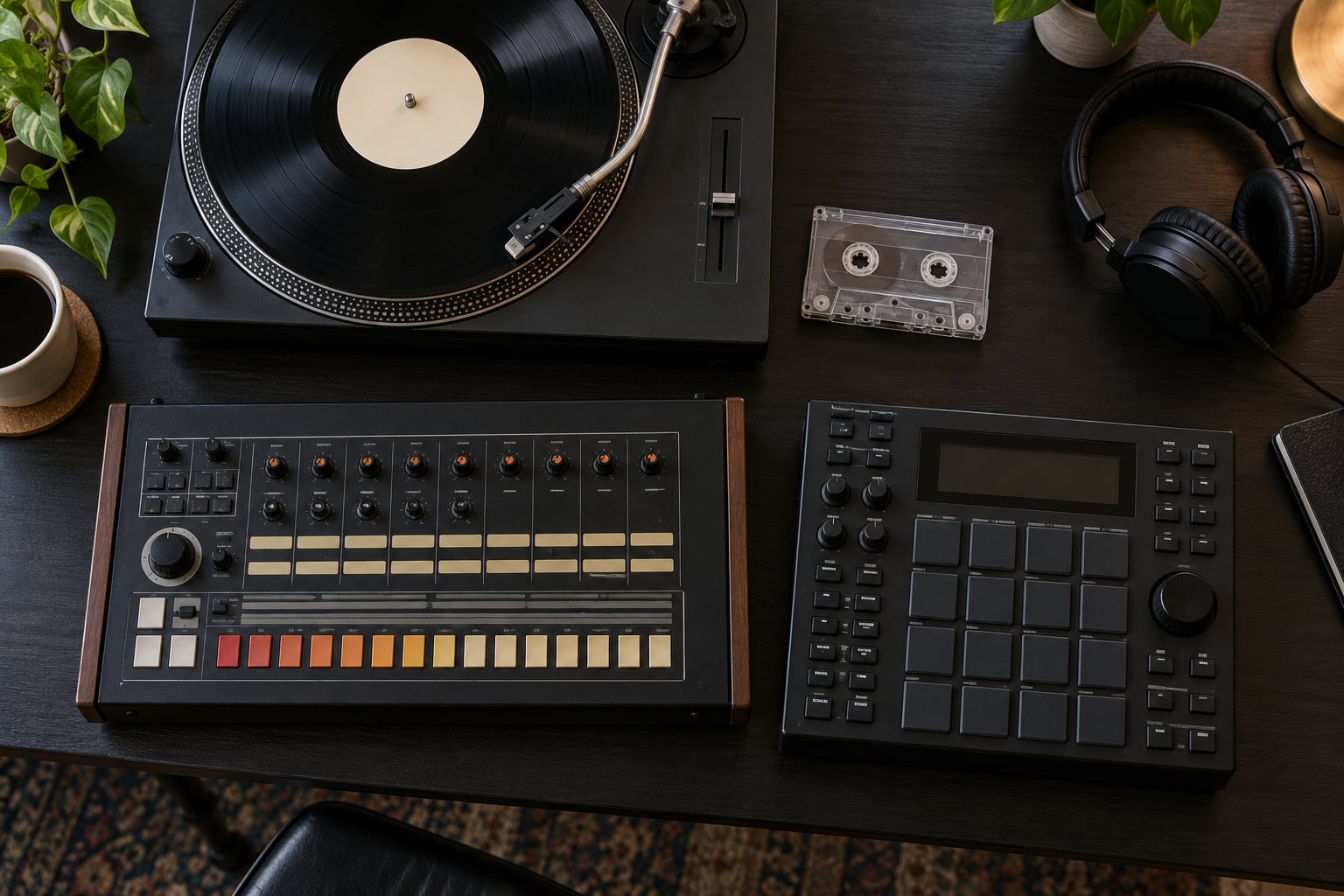
What has changed is access. A sampler, a pad and a turntable once put a machine with poor resolution and no memory between the producer and the source, and those limitations became a signature. Modern software removes most of the friction, and the character of the source can be preserved almost exactly. That is the real shift: the sound is cleaner, the sources are more legible to rights holders, and the skill now sits in the choices rather than in the gear.
One genuine new tension has come with it. Machine-based stem separation can pull a voice or a drum kit out of a finished record, which turns any song into a potential source, and the legal questions around that sit well outside what the older cases were written to address. Producers are working through it right now, mostly by staying on the cautious side.
Frequently Asked Questions
What does sampling mean in hip hop?
Sampling in hip hop is the reuse of part of an existing sound recording inside a new song. A producer takes a fragment of an earlier record, such as a drum break, bassline, guitar part or vocal, and rebuilds it into a new beat by looping, chopping, pitch shifting, time stretching, filtering or layering it. Sampling has been central to hip hop since the 1970s.
Is sampling the same as using a loop?
Not quite. A loop is any repeating section of audio, including one you recorded yourself or one generated by a synth. A sample is specifically material taken from an existing recording, and it can be looped. So every looped sample is a loop, but not every loop is a sample. When people use the words interchangeably in conversation, they usually mean the same thing in practice.
What genre started the tradition of hip hop sampling?
The source material was mostly funk, soul and disco, with jazz, Caribbean-influenced music and early electronic records feeding in as well. These were the records DJs played and extended at Bronx parties in the early 1970s. The genre that sampling itself created was hip hop, but the sounds it borrowed from came from Black American musical traditions that had already been passing material forward for generations.
How did chopping change hip hop production?
Chopping cuts a sample into small pieces and plays them in a new order, so the same few bars can be rearranged into a pattern that never existed on the source record. It gave producers the ability to shift a groove without losing its identity, made drum programming far less necessary, and became a defining technique across boom bap, G-funk, jazz rap and modern trap production.
Do producers need permission to sample a song?
For a commercial release, yes, in most cases. A sample usually involves two rights: the master recording and the underlying composition, and both may need to be licensed. Very short, heavily transformed uses are sometimes protected, but that depends on the facts and on the jurisdiction. This is general information rather than legal advice, so anyone with real money involved should consult a music attorney.
Is sampling still common in modern hip hop?
Yes, though it looks different. Most current production borrows very short fragments rather than a full hook, then processes them heavily. Chopped vocal syllables, pitched loop beds and stems pulled from finished records are all current practice, and sample libraries have made the source material vastly easier to find. The tools changed more than the habit did.
Conclusion
How sampling shaped modern hip hop is a story about a practical need turning into an identity. A DJ needed more room, so a break got extended. A producer needed an arrangement, so a record got cut up. A generation needed to argue with the music that came before it, so the argument got built into the beat.
Start by listening closely to one record and following its sources. Pick a track with an obvious loop, find the original, and note what the producer kept, what got thrown away, and what was changed on purpose. Do that a few times and the whole lineage of the genre becomes audible, which is a better way to understand it than any history book.
Last updated: October 2026.