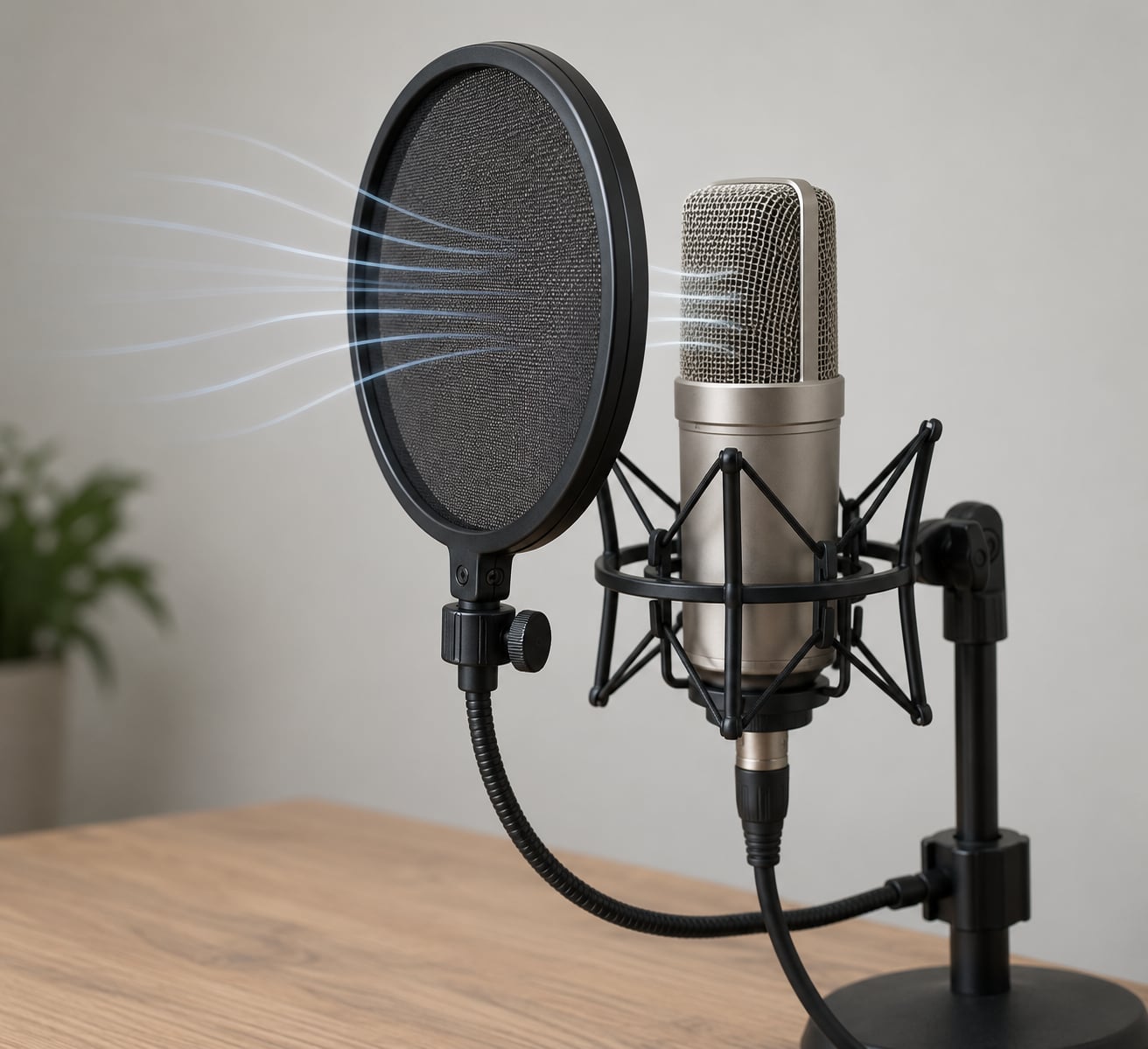
A pop filter is a screen of acoustically transparent material — mesh, foam or fabric — that sits in front of a microphone and softens the bursts of air produced by plosive consonants like P, B and T. Yes, it matters: any time you sing or speak close to a mic, it is the cheapest way to stop those thumps from ruining a take. If you are new to recording, test your setup before you spend on hardware.
Table of Contents
- What Is a Pop Filter and Does It Matter?
- How Does a Pop Filter Reduce Plosives and Breath Noise?
- Does a Pop Filter Matter for Every Recording Setup?
- What Are the Main Types of Pop Filters?
- How Do You Choose the Right Pop Filter for Your Microphone?
- How Do You Use a Pop Filter Correctly?
- Common Pop Filter Mistakes and Quick Fixes
- Frequently Asked Questions
- The Short Version
What Is a Pop Filter and Does It Matter?
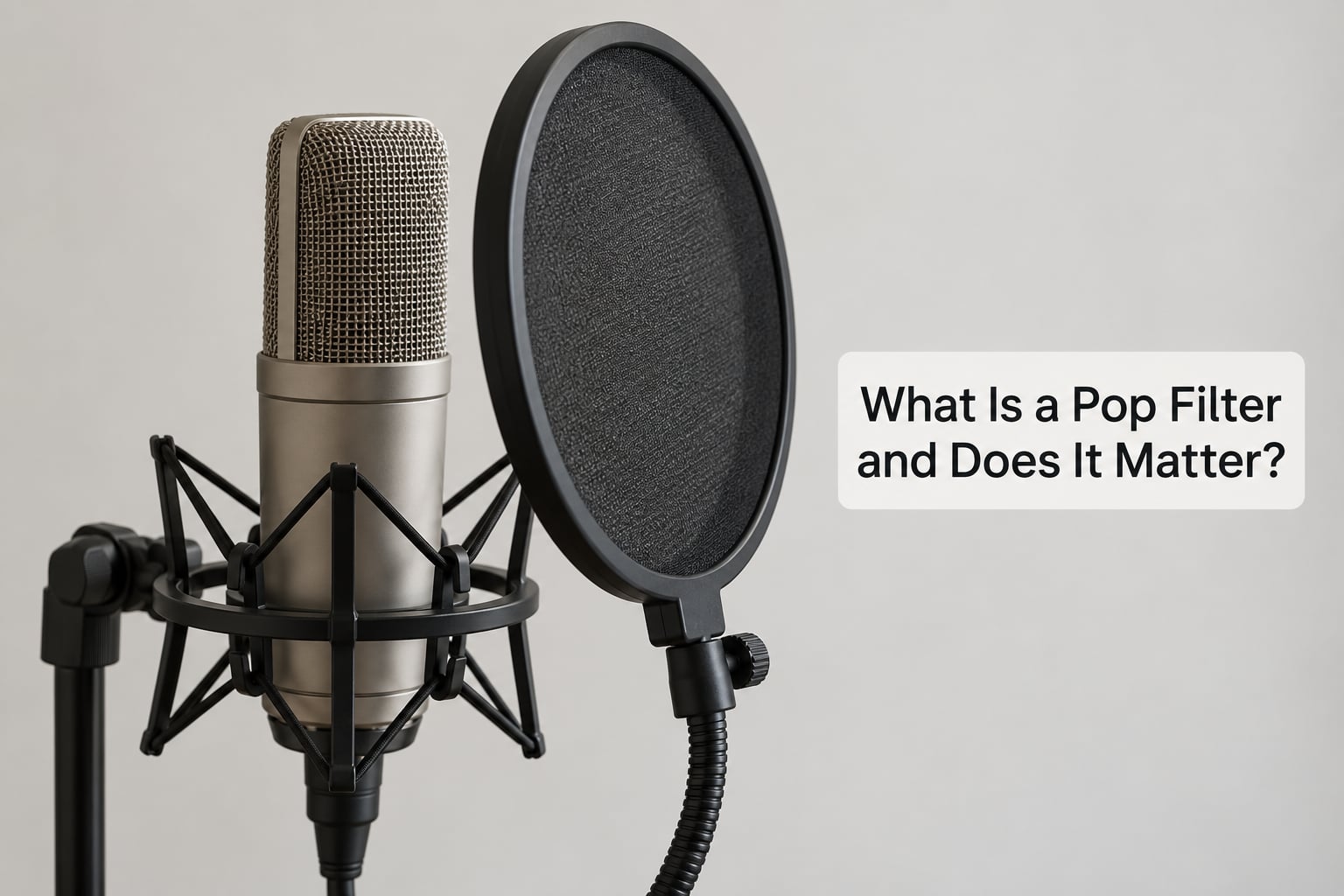
Short answer: yes, on any close-mic’d vocal take, it is worth having.
Plosives happen because your mouth releases a small pocket of compressed air directly at the capsule. The microphone diaphragm gets hit hard and reports a low-frequency thump instead of your voice. A pop filter sits in the path and takes the edge off that burst before it arrives.
It matters most when you are recording vocals, voiceover, podcasting or streaming from a few inches away. It matters less when the microphone is a foot or two back, pointed slightly off-axis, or already protected by an internal windscreen and foam layer.
Here is what a filter handles and what it leaves alone:
- Tames hard P, B and T bursts
- Softens breathy consonants like F and H on quiet phrases
- Keeps saliva and moisture off the capsule, which extends mic life
- Does not control level, clipping, sibilance, room echo or a sore-sounding voice
That last line matters more than most product pages admit. A pop filter is a plosive tool. If your levels are clipping, the fix is gain staging, not mesh.
How Does a Pop Filter Reduce Plosives and Breath Noise?
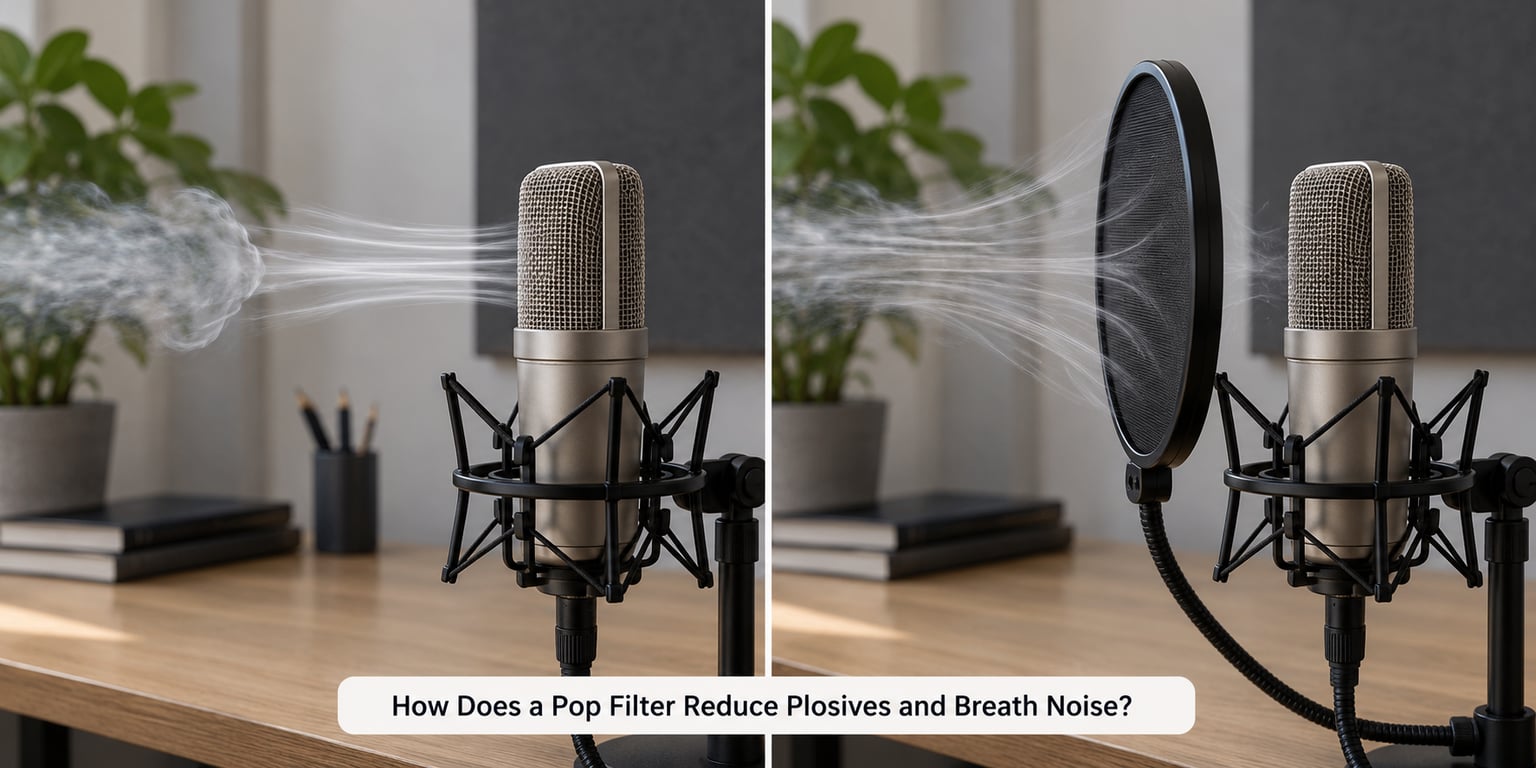
A plosive is a short, high-velocity pressure wave — the puff of air that escapes when you say P, B or T right against the mic.
That wave hits a thin, light diaphragm and pushes it much further than a normal vocal sound would. The diaphragm moves, the electronics amplify what just happened, and you hear a bump or a smeary distortion rather than a clean consonant.
Mesh works against that in two ways. It forces the fast air through many tiny openings, which slows the flow down, and it spreads the arriving energy over a wider area so the capsule is nudged instead of slammed. Adding an air gap between the filter and the capsule gives that slowed air room to dissipate rather than slamming straight into the mic.
Foam works differently. It absorbs and breaks up the air over a thicker depth, which makes it better on airflow than on individual pops, but it also dulls the top end.
That last trade-off is why vocalists tend to avoid foam. Engineers on audio forums keep repeating the same point: hoop-and-nylon screens have never given them trouble, while foam sock types can do things to the sound they would rather avoid.
A filter cannot remove every pop, either. Angling the mic slightly off-axis or turning your mouth a few degrees away from the capsule catches what the mesh misses. That is still the cheapest fix on the desk.
Does a Pop Filter Matter for Every Recording Setup?
It matters most for sensitive capsules and close distances, and least for directional mics used at arm’s length.
| Microphone or source | How much it matters | Why |
|---|---|---|
| Large-diaphragm condenser | High | Fast transient response, low self-noise, usually worked close |
| Small-diaphragm condenser | High | Same sensitivity, less internal protection in many models |
| Dynamic vocal mic (SM58, SM7B class) | Medium | Handle plosives better, but they still thump at 3 inches with gain up |
| Shotgun mic | Low | Very directional and usually used off-axis at 15-20 cm |
| Headset or wearable mic | Low to medium | Off-axis placement already spreads the burst; breath noise can still arrive |
| USB condenser | High | Fixed gain and fixed position, no adjustment when it pops |
| Lavalier on fabric | Low for plosives | Rubbing noise and wind need a foam cover, not a mesh hoop |
| Amplified instrument or speaker | Low | Air movement is not aimed at the capsule |
Two situations where I would skip it: an outdoors shotgun recording where a good foam windscreen is doing the real work, and a tracking session where the engineer prefers to place the mic just outside the plosive path. Plenty of working engineers do exactly that and solve it with mic angle instead of adding a filter.
What Are the Main Types of Pop Filters?
Most filters are one of four constructions, and the differences show up in pop control, tone and build quality.
| Type | Pop reduction | Breath control | Typical use | Cost positioning |
|---|---|---|---|---|
| Single-layer nylon mesh | Moderate | Low | Home studio, podcasting, beginners | Entry |
| Double-layer mesh | High | Medium | Loud singers, close condenser work | Mid to upper mid |
| Perforated metal, single layer | Moderate to high | Medium | Durable studio use, edge vocals | Mid to upper |
| Metal with a thin inner screen | High | High | Broadcast and treated rooms | Upper |
| Foam cover (mic sock) | Low for plosives | High | Wind, field recording, handheld mics | Entry |
| DIY stocking on a hoop | Low to moderate | Medium | Temporary or backup use | Free |
Nylon loses a touch of high end, which some singers prefer for a warmer vocal. Metal keeps more top-end bite. That is a taste call, not a correctness call.
Mounting styles matter more than most buyers expect. Clamp-on filters grip a mic stand or boom arm and stay put. Gooseneck filters screw into the mic body or shock mount and drift out of position over a session — a complaint that comes up constantly on audio forums. On a wide filter, the weight also pulls down a lightweight boom arm, so match the filter diameter to the stand you already own.
Large vocal filters with a curved inner screen spread airflow around the singer and let you move around more. Useful for animated performers, overkill for a first home mic.
How Do You Choose the Right Pop Filter for Your Microphone?
Pick a filter that fits the mic physically and stays stable on your stand.
- Diameter: wide enough that you can sing behind it without touching the mesh, narrow enough that your stand holds it steady.
- Mounting: clamp-on for fixed stands, shock-mount mount for mics that live in a suspension cradle, gooseneck only if you re-tighten it between takes.
- Layers: one mesh layer handles most singers at normal levels. Two layers help if you are loud, close, and already hitting the preamp hard.
- Mesh vs metal: both work. Metal lasts longer and takes a knock; nylon sounds slightly softer and costs less.
Skip anything marketed as a vocal beautifier, tone shaper or “broadcast magic.” A pop filter is a physical air device. Features that shape tone are a different product, usually doing EQ in hardware.
What is a pop filter and does it matter for home recording?
For most home studios, it matters on the first take, not the tenth.
Home mics are usually small-diaphragm condensers on a cheap stand, close to the singer, with gain cranked up. That is the worst case for popping. A nylon hoop on a clamp fixes it for less than the cost of one re-recorded session.
The one exception is a USB mic with a built-in shock mount and foam head. Record a test before buying anything, which brings us to placement.
How Do You Use a Pop Filter Correctly?
Distance and alignment decide whether a filter works, not the filter itself.
- Set the mic first. Aim it at your mouth with the stand locked, then leave the stand alone.
- Put the filter 10-15 cm in front of the capsule. Flush against the mic removes the air gap and the filter does almost nothing.
- Stand 15-20 cm behind the filter. The mesh creates a zone, not a wall — the burst needs somewhere to spread.
- Keep it level with the capsule. A filter sagging below the mic splits the burst instead of catching it.
- Avoid the rim. Singing into the outer edge sends air around the mesh and past the filter entirely.
- Record 20 seconds and listen. Say P, B, T and F at your loudest, then walk slightly off-axis and try again.
That last test doubles as a working-distance marker. Performers who repeat takes from the same spot get more consistent level and tone between them, which is worth more than any hardware swap.
Common Pop Filter Mistakes and Quick Fixes
Mistake 1: the filter sits flush against the mic. No air gap means no dissipation. Pull it out to a hand’s width and retest.
Mistake 2: the singer stands well behind the filter. Distance past the filter reduces the effectiveness of the mesh. Keep the mouth close to the screen and far from the capsule.
Mistake 3: the filter hangs below the capsule. Air finds the gap. Raise the filter so its centre lines up with the grille.
Mistake 4: gain is too high. Popping feels like a level problem, so people add mesh instead of turning the preamp down. On r/singing, engineers repeat the same point: pop filters control plosives, not volume. Set your peaks where your converter is happy, then judge the filter.
Mistake 5: confusing plosives with sibilance. A pop filter will not fix S and T sharpness — that is a de-esser, or a gentle high-shelf cut around 6-10 kHz, or simply a lighter vocal tone. Play the take back before you buy anything.
Mistake 6: never cleaning it. Foam and mesh collect saliva, dust and skin oil, which dulls the sound and can smear the high end over time. Wipe it monthly and replace foam when it turns crumbly.
Frequently Asked Questions
Do I need a pop filter if I own a dynamic microphone?
A dynamic microphone handles plosives better than a condenser, so one is optional at normal distances. At three inches with gain up, though, P and B bursts still thump hard enough to edit. If you record vocals on a dynamic, try a take without a filter first and decide from the playback rather than the spec sheet.
Can a pop filter replace a microphone windscreen?
No, they solve different problems. A pop filter disperses high-velocity air from plosive consonants in front of the capsule. A windscreen, or foam cover, handles steady airflow like wind, breath at distance, and handling noise. Using both is common on shotgun and field recordings; on a studio condenser, a good mesh filter is usually enough.
Does a pop filter make vocals sound better overall?
It makes one narrow thing better: the consonant transients no longer thump. It will not change the tone of the vocal, warm anything up, or make a plain performance exciting. In my experience it removes the irritation that makes listeners reach for the volume button, which feels like a big improvement even though the frequency response barely moves.
How far should a singer stand from a pop filter?
About 15-20 cm behind the filter, with the filter itself 10-15 cm in front of the microphone. That keeps a proper air gap on the mic side and lets the singer stay close enough to the mesh for it to catch the burst. Record a short test and adjust by ear, since every voice and capsule differs.
Is a double-layer pop filter always better?
No. Two layers slow the air more and catch louder or closer singers, but they also add a little more to the signal path and can dull the top end. A single-layer nylon hoop handles most home studio vocals fine. Go double if you sing hard at three inches, or if single-layer tests still leave audible pops.
Can a pop filter fix sibilance?
Not really. Sibilance is the harsh, piercing edge on S, T and F sounds, and a pop filter is built to slow down air bursts, not to tame high-frequency energy. Use a de-esser, reduce gain, or ease the singer back slightly. If sibilance is the problem, buying a pop filter will not fix it.
The Short Version
A pop filter matters whenever a voice is recorded close to a sensitive microphone, and it does almost nothing for level, sibilance or room problems.
Do this first: record twenty seconds of P, B, T and F at your loudest and closest position with no filter in the way. If the take thumps, add a clamp-mounted mesh hoop, keep a 10-15 cm gap in front of the capsule, and stand 15-20 cm behind it. Everything else on the list can wait.